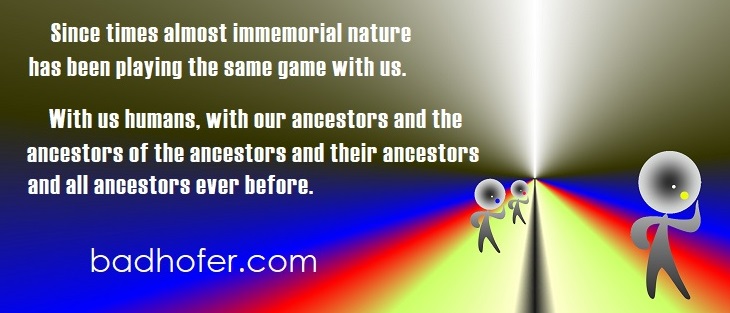

 At the
beginning of the 21st century, humanity
possesses sufficient knowledge to bring this
seemingly endless cycle to completion. But who
is in a position to set the process in motion?
It is inherent in scientific innovation that fundamentally new possibilities have no established path to follow. Moreover, the examination of such questions often falls neither clearly within the competence nor the responsibility of any single individual or institution. Nor is there any immediate practical necessity to address them. Should we therefore allow this process - which is not really a game at all - to continue for several more generations? It is not an easy decision. Current scientific and institutional structures may make it difficult to address such questions in a timely manner. Perhaps the next generation will have to take up the challenge. Had Aristarchus of Samos, Copernicus, Galileo, Kepler, and Newton not possessed the courage to publish discoveries that contradicted the prevailing worldview of their time, we might still believe that the Sun revolves around the Earth. Likewise, the evolution of humankind would scarcely have been possible had our evolutionary ancestors never left their ancestral habitats. If they had lacked the courage to climb down from the trees, we might still be living in them today. A frequently quoted statement by the physicist and Nobel laureate Max Planck reads: "A new scientific truth does not triumph by convincing its opponents and making them see the light, but rather because its opponents eventually die, and a new generation grows up that is familiar with it." Whether a new hypothesis ultimately endures is therefore determined neither by the persuasiveness of its proponents nor by the resistance of its critics, but by its ability to withstand scientific scrutiny and to be supported by verifiable evidence. The history of science suggests that sound ideas ultimately prevail, even if this process sometimes takes several generations. Be that as it may, sooner or later the sun rises. If not during this generation, then perhaps during the next. |
 |
Why is there
actually something and not just nothing?
continue: 2kugel.comThis question is the oldest and most fundamental question that has ever existed. To answer this question, you have to start from the very beginning. The very beginning is where the question no longer arises: "What was there before?" ABSOLUTELY NOTHING is the only term that no longer raises the question: "What was there before?" Absolutely nothing has never existed, because if there had ever been absolutely nothing, it would have always stayed that way. Because in absolute nothingness there would of course have been no possibility that this state would ever change, because even the slightest possibility would have been more than absolutely nothing. SOMETHING has therefore always been there, because if this SOMETHING had come into being, there would have been absolutely (without exception) nothing before its creation and it would have always stayed that way. However, why hasn't there been nothing without exception and why did it not remain so? |
|
Imprint: Epistemology badhofer steyr - AUSTRIA heinrich@badhofer.com badhofer.com |